

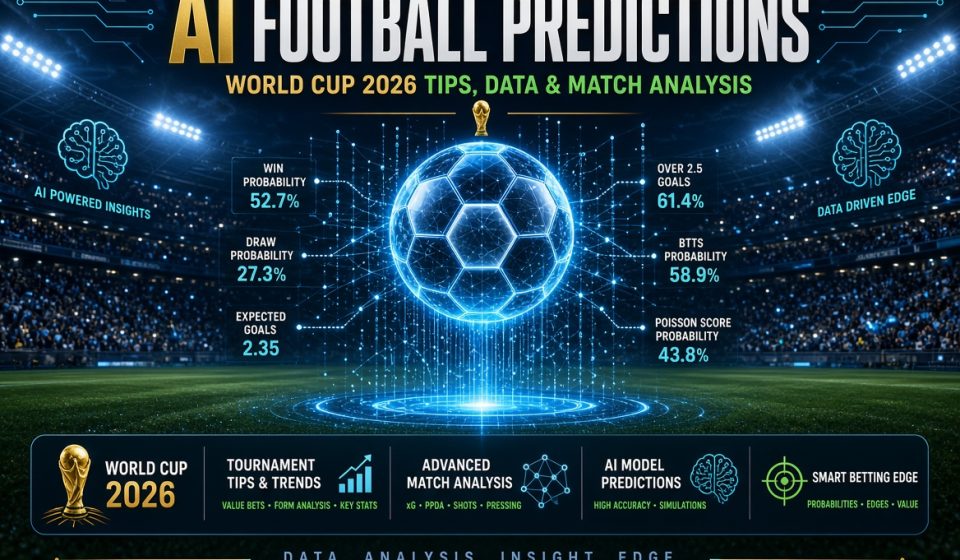
AI Football Predictions: World Cup 2026 Tips, Data & Match Analysis

AI football predictions are becoming an increasingly popular way for football fans to analyse matches, team form, player availability and betting markets. Instead of relying only on reputation or personal opinion, modern football prediction models combine historical results, expected goals, team ratings, player data and probability calculations to estimate possible match outcomes.
The FIFA World Cup 2026 provides a major test for these prediction systems. With 48 teams competing across Canada, Mexico and the United States, the tournament will feature different playing styles, tactical approaches, travel conditions and knockout-stage pressure.
However, AI does not know the future. A football prediction is a probability estimate, not a guaranteed result.
This guide explains how AI football predictions work, which data matters most, how to analyse World Cup matches and how football fans can use prediction models more responsibly.
What Are AI Football Predictions?
AI football predictions are forecasts generated using statistical models, machine learning and football data.
A basic prediction might simply identify the team most likely to win. More advanced systems calculate probabilities for several possible outcomes.
For example:
- Team A win: 52%
- Draw: 27%
- Team B win: 21%
This does not mean Team A is guaranteed to win. Instead, the model considers Team A the most likely outcome based on the available information.
AI football prediction systems can analyse:
- Match winners
- Draw probabilities
- Double chance
- Over and under goals
- Both teams to score
- Correct scores
- First-team-to-score markets
- Tournament winners
- Qualification probabilities
The strongest prediction systems also explain the factors behind the forecast rather than presenting an unexplained “sure win”.
FIFA World Cup 2026 Predictions
The FIFA World Cup 2026 is the first edition of the tournament featuring 48 teams.
Canada, Mexico and the United States are hosting the competition, creating a unique environment for football prediction models.
AI systems can analyse each World Cup fixture using factors such as:
- Recent international form
- Team strength
- Expected goals
- Goals scored and conceded
- Player availability
- Injuries and suspensions
- Expected starting line-ups
- Tactical matchups
- Squad depth
- Rest periods
- Travel requirements
- Venue conditions
- Weather
- Tournament motivation
The expanded format also creates additional qualification scenarios. That means a team’s motivation can change significantly depending on its position in the group.
A model that ignores match context can therefore produce a weaker prediction.
How AI Football Prediction Models Work
There is no single formula capable of predicting every football result.
Instead, modern systems can combine several statistical methods.
Elo Ratings
Elo-style ratings estimate the relative strength of football teams.
A team’s rating changes after matches depending on the opponent and result. This provides a longer-term measurement of team strength than simply looking at the latest league table.
Elo ratings can be particularly useful in international football because national teams play fewer matches than club teams.
Expected Goals
Expected goals, commonly called xG, measure the quality of scoring opportunities.
A team can win a match despite creating fewer chances than its opponent. Likewise, a team can lose despite producing several high-quality opportunities.
xG helps prediction models identify underlying attacking and defensive performance instead of relying exclusively on final scores.
Poisson Goal Models
Poisson models estimate the probability of different goal totals.
A model may calculate the probability of:
- 0 goals
- 1 goal
- 2 goals
- 3 goals
- 4 or more goals
Those probabilities can then be used to estimate possible scorelines and goal-related markets.
Machine Learning
Machine-learning models can process large quantities of football information.
Depending on the system, inputs can include:
- Recent results
- Goals
- xG
- Shots
- Possession
- Defensive actions
- Player availability
- Team ratings
- Opponent strength
- Rest days
- Home advantage
- Market prices
The model then identifies patterns in historical data and produces probability estimates.
What Data Matters Most?
The quality of an AI football prediction depends heavily on the quality of its data.
Recent Team Form
Recent results can provide useful information about current performance.
However, five consecutive wins do not automatically mean a team is stronger than its opponent. The quality of those opponents also matters.
A model should therefore consider opponent strength alongside recent results.
Expected Goals
xG can help identify teams whose results may not accurately reflect their performances.
For example, a team might win several matches by narrow margins while consistently creating high-quality chances. Another team might collect points despite producing relatively little attacking threat.
That difference can become important when making future match predictions.
Player Availability
Injuries and suspensions can significantly change a football prediction.
Losing a first-choice goalkeeper, centre-back or main striker may have a greater effect than a model based only on team-level historical results suggests.
For international tournaments, squad depth is particularly important because replacement options can vary significantly between countries.
Tactical Matchups
Football is not simply a comparison of team ratings.
One team’s style can create problems for another team’s system.
For example, a side that struggles against aggressive pressing may face difficulties against a high-energy opponent. Meanwhile, a team with dangerous counter-attacking players may benefit against an opponent that commits many players forward.
Good AI football predictions should therefore consider tactical compatibility whenever reliable data is available.
AI Football Predictions vs Traditional Football Tips
Traditional football tips often rely on human judgement, experience and recent observations.
AI prediction systems approach the problem differently.
| Factor | Traditional Tips | AI Football Predictions |
|---|---|---|
| Recent form | Usually considered | Analysed statistically |
| Team strength | Expert judgement | Ratings and historical data |
| xG | Sometimes used | Frequently incorporated |
| Player availability | Human assessment | Data input |
| Probability | Often absent | Core component |
| Large datasets | Limited | Can process large datasets |
| Bias | Can be influenced by opinion | Can reduce some human bias |
| Certainty | Sometimes exaggerated | Should use probabilities |
Neither approach is perfect.
The best football analysis can combine statistical models with human knowledge of team news, tactics and match circumstances.
How to Read an AI Football Prediction
A prediction should not simply be read as “Team A will win”.
Instead, look at the probability distribution.
Imagine a model produces:
Home win: 48%
Draw: 29%
Away win: 23%
The home team is the favourite, but there is still a 52% combined probability of a draw or away victory.
That distinction is extremely important.
A 48% probability is not a prediction of certainty. It means the model believes the outcome is more likely than the alternatives individually.
This is why responsible football analysis should focus on probability rather than phrases such as “guaranteed win”, “fixed match” or “sure odds”.
AI Football Predictions and Betting Value
One of the most useful applications of probability models is comparing a model’s estimate with available betting odds.
Suppose an AI model gives Team A a 50% probability of winning.
The model’s estimated fair decimal price would be:
1 ÷ 0.50 = 2.00
If a bookmaker offers odds of 2.20, the price may appear more attractive than the model’s estimated fair price.
However, this does not guarantee profit.
The model could be wrong. The data could be incomplete. Team news could change. Or the match could simply produce an unexpected result.
Therefore, AI football predictions should be used as one part of an analytical process rather than as an automatic betting signal.
Best Markets for AI Football Analysis
Different betting markets have different levels of uncertainty.
Match Result
AI can estimate the probability of a home win, draw or away win using team strength, form, xG and other variables.
Over or Under Goals
Goal models can estimate the likelihood of a match producing more or fewer goals than a specified line.
Both Teams to Score
This market can be analysed using attacking output, defensive performance and expected goals.
Double Chance
Double-chance markets combine two possible outcomes and can reduce the number of ways a selection can lose, although the odds are usually lower.
Correct Score
Correct-score predictions are much more difficult because they require a highly specific outcome.
Even when a model identifies the most likely scoreline, that score may still have a relatively low probability.
Tournament Winner
Predicting a World Cup winner requires a much longer-term model.
The system needs to account for:
- Squad depth
- Draw structure
- Team strength
- Injuries
- Potential opponents
- Knockout variance
- Tactical matchups
- Tournament progression
A team can be one of the strongest sides in the competition and still fail to win the tournament.
What Makes a Reliable AI Football Prediction?
Not every prediction website uses the same quality of methodology.
Football fans should look for transparent analysis rather than exaggerated claims.
A useful AI football prediction platform should provide:
- Clear methodology
- Probability-based predictions
- Recent team information
- Player availability
- Statistical evidence
- Updated match data
- Historical performance tracking
- Clear limitations
- Responsible betting information
Avoid platforms that claim to provide guaranteed football results.
No legitimate statistical model can remove uncertainty from football.
A prediction that says “100% guaranteed win” should be treated with extreme caution.
Common Mistakes When Using AI Football Predictions
AI can improve analysis, but users can still make poor decisions.
Betting Only Because a Team Is the Favourite
Being the favourite does not automatically mean the odds provide good value.
Ignoring Team News
An important injury or unexpected line-up change can significantly alter a prediction.
Chasing Losses
One unsuccessful prediction does not mean the next stake should be increased.
Treating Probability as Certainty
A 70% prediction still has a 30% chance of not occurring according to the model.
Following “Sure Win” Claims
Football contains too much randomness for guaranteed-result claims to be credible.
Overloading One Match
Placing many selections on the same match can increase exposure without necessarily improving the underlying decision.
How to Use AI Football Predictions More Effectively
A disciplined analysis process can be simple.
Step 1: Check the Model
Look at the predicted probabilities rather than only the headline selection.
Step 2: Check Team News
Review injuries, suspensions and confirmed line-ups before making a decision.
Step 3: Study Recent Performance
Consider results alongside xG, goals, defensive performance and opponent quality.
Step 4: Consider Match Context
Ask whether the game is a group match, knockout match, friendly or qualifier.
Step 5: Compare the Price
If betting, compare the available odds with your estimated probability.
Step 6: Control Your Stake
Never increase a stake simply because a previous prediction lost.
Step 7: Track Results
Record predictions over time instead of judging a model based on one or two matches.
Why World Cup Matches Are Difficult to Predict
International tournaments create additional uncertainty.
National teams have limited preparation time compared with club teams. Players arrive from different leagues, tactical systems and competitive environments.
There can also be major differences in:
- Travel
- Climate
- Time zones
- Squad chemistry
- Tactical preparation
- Player fatigue
- Tournament pressure
Knockout matches introduce another layer of uncertainty.
A team that would normally attack aggressively may become more conservative when elimination is at stake.
Therefore, even the best AI football predictions should be treated as probability estimates.
AI Football Predictions for Nigeria and African Football
AI football analysis is particularly useful for following African football because international fixtures can involve limited publicly available data compared with Europe’s major leagues.
For Nigeria, prediction models can examine:
- Super Eagles form
- Player availability
- European club performances
- Expected line-ups
- Goalscoring trends
- Defensive records
- Opponent strength
- Recent international fixtures
This can help football fans analyse Nigeria football predictions, Super Eagles matches and major international fixtures.
However, data quality remains essential. If information about injuries, line-ups or recent performances is incomplete, prediction confidence should be reduced.
Can AI Predict Football Correctly Every Time?
No.
AI can improve the quality of analysis, but football remains unpredictable.
A team with a 70% estimated chance of winning can still lose.
An early red card, penalty, goalkeeper error, injury or individual moment of brilliance can completely change a match.
This is why the most credible prediction systems communicate uncertainty rather than pretending to eliminate it.
The objective is not to predict every result correctly.
The objective is to make better-informed probability assessments.
Frequently Asked Questions
What are AI football predictions?
AI football predictions are probability-based forecasts generated using football statistics, historical results, team ratings, player information and machine-learning or statistical models.
Are AI football predictions accurate?
AI can identify patterns and produce useful probability estimates, but no system can guarantee accurate results for every match.
Can AI predict FIFA World Cup 2026 matches?
Yes. AI models can analyse World Cup matches using team strength, form, player availability, xG, tactical data and other information. However, World Cup results remain uncertain.
What is the best data for football predictions?
Useful data includes expected goals, recent form, opponent strength, player availability, goals scored and conceded, team ratings and tactical information.
Can AI football predictions help with betting?
They can help users understand probabilities and compare potential outcomes with market prices. However, predictions do not guarantee profit and should never be treated as guaranteed betting advice.
What is xG in football predictions?
Expected goals, or xG, estimates the quality and likelihood of scoring chances. It can provide more information about attacking performance than goals alone.
Are World Cup predictions guaranteed?
No. Even the strongest statistical model cannot guarantee a World Cup result.
Can AI predict the World Cup winner?
AI can estimate tournament probabilities and simulate possible outcomes, but injuries, draws, tactical matchups and knockout-stage variance can dramatically change the tournament.
Final Verdict: Are AI Football Predictions Worth Using?
AI football predictions can be a powerful football analysis tool when used correctly.
They allow fans to move beyond simple opinions and examine probabilities, team form, xG, player availability, tactical matchups and market prices.
For the FIFA World Cup 2026, these tools can make match analysis more structured and informative.
However, the most important principle is simple:
A prediction is not a guarantee.
Use AI to understand the numbers, combine it with reliable team news and football knowledge, and always recognise the uncertainty involved in the sport.
For BALL1TH readers, the goal should be smarter football analysis—not unrealistic promises of guaranteed winners.
Responsible Betting Notice
18+ only. Betting involves financial risk. Never bet money you cannot afford to lose. Do not chase losses or treat football predictions as guaranteed income.