
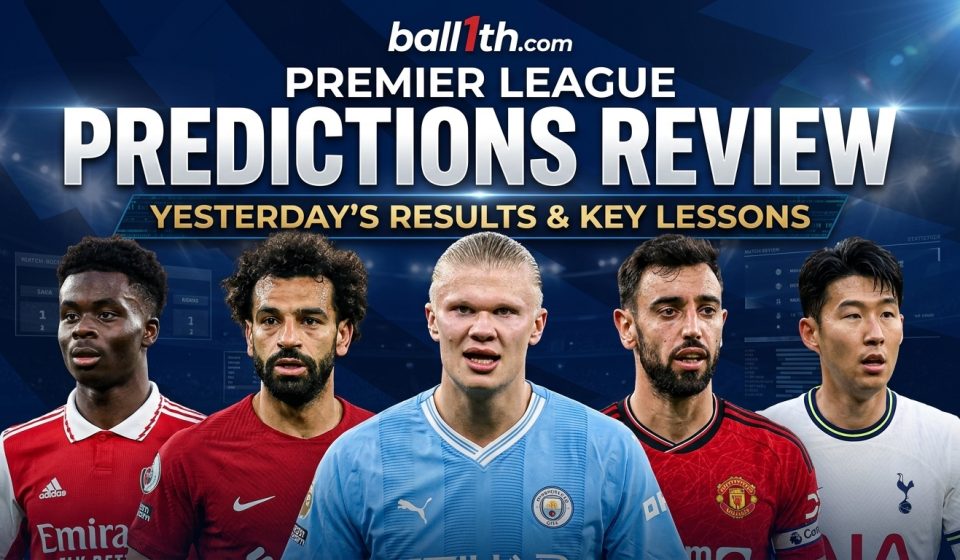
Premier League Predictions Review: Yesterday’s Results and Key Lessons

Updated: 14 October 2026 | Competition: English Premier League | Matchweek 6
Yesterday’s football results offer important lessons for anyone following Premier League predictions. Arsenal defeated Leeds United 2–1, Manchester United drew 1–1 with Tottenham Hotspur, and Coventry City produced a major surprise by beating Newcastle United 4–1.
At BALL1TH, reviewing completed matches is an important part of football analysis. Therefore, this article compares the results with the original Matchweek 6 selections, examines what happened, and explains how these outcomes can inform future predictions.
However, a correct result does not automatically mean that every aspect of a prediction was correct. For example, selecting Arsenal to win is different from predicting an exact 2–1 scoreline. Similarly, a team can dominate parts of a match without securing all three points.
Yesterday’s Premier League Results and Original Predictions
The table below compares the original selections supplied for this review with the reported final scores.
| Fixture | Original BALL1TH pick | Final score | Outcome |
|---|---|---|---|
| Arsenal vs Leeds United | Arsenal win — 82% | 2–1 | Correct |
| Manchester United vs Tottenham Hotspur | Manchester United win — 62% | 1–1 | Incorrect |
| Coventry City vs Newcastle United | Newcastle United win — 72% | 4–1 | Incorrect |
Arsenal delivered the only correct full-time winner selection among these three examples. Meanwhile, Manchester United failed to win at home, and Newcastle United suffered a heavy defeat against Coventry City.
Consequently, this review highlights why predictions should be evaluated against the actual selections published before kick-off. The three fixtures provide useful examples, although they are not enough to establish the overall accuracy of every Matchweek 6 prediction on BALL1TH.
Arsenal 2–1 Leeds United: The Winning Prediction
Arsenal secured a 2–1 victory over Leeds United after responding to a difficult spell during the match. Although Leeds managed to take the lead, Arsenal found a way back into the contest and eventually secured all three points.
The result matched the original BALL1TH selection of an Arsenal win, which carried an estimated probability of 82%.
What went right?
Arsenal’s victory supports the full-time winner selection. Moreover, their ability to respond after falling behind demonstrates why a team’s attacking options and match management can be important considerations in a football preview.
Nevertheless, the correct winner does not prove that every detail of the match was predictable. Leeds remained competitive, and the final score was closer than a comfortable victory might suggest.
What should readers learn?
First, a strong pre-match selection can still involve uncertainty. Secondly, a team’s ability to respond to setbacks may influence the final outcome. Finally, readers should distinguish between a correct match-winner prediction and an exact-score prediction.
Original selection: Arsenal to win.
Original estimate: 82%.
Final result: Arsenal won 2–1.
Review: The match-winner selection was correct. However, the 82% figure should be understood as the original estimate, not as a guarantee of success.
Manchester United 1–1 Tottenham Hotspur: A Prediction Miss
Manchester United and Tottenham Hotspur shared the points after a 1–1 draw. The result did not match the original BALL1TH selection of a Manchester United win, which carried an estimated probability of 62%.
Although Manchester United were expected to win according to that selection, Tottenham managed to leave the fixture with a point. Therefore, this match demonstrates why a predicted favourite cannot be treated as a guaranteed winner.
Why is this result important?
A full-time winner prediction depends on several factors, including attacking effectiveness, defensive organisation, player availability, and match circumstances. Furthermore, a game can change quickly because of substitutions, late goals, or individual mistakes.
A draw also shows why it is useful to consider different possible outcomes during the analysis stage. However, that does not mean a draw would automatically have been the correct prediction before kick-off.
What should readers learn?
The original Manchester United win selection must be recorded as incorrect for the full-time result market. In addition, future previews should consider how closely matched opponents may be and whether the available evidence supports a confident home-win selection.
Original selection: Manchester United to win.
Original estimate: 62%.
Final result: 1–1 draw.
Review: The full-time winner selection was incorrect. The result reinforces the need to account for uncertainty even when a team is favoured.
Coventry City 4–1 Newcastle United: The Biggest Surprise
Coventry City delivered the most striking result in this review by beating Newcastle United 4–1. The outcome contradicted the original BALL1TH selection of a Newcastle United win, which carried an estimated probability of 72%.
Instead of securing the expected victory, Newcastle conceded four goals. Coventry, meanwhile, took advantage of its opportunities and produced a convincing result.
What made this result significant?
The match highlights the limits of relying on team reputation alone. Even when one side appears stronger before kick-off, the actual contest may develop differently.
Moreover, home advantage, tactical execution, defensive mistakes, and finishing can all influence a match. Nevertheless, a single result cannot prove that one team will continue performing well or that another will keep struggling.
What should readers learn?
First, pre-match analysis should consider how each team might approach the game. Secondly, defensive weaknesses may influence the likely number of goals. Finally, predictions should be reviewed honestly when the final outcome contradicts the original selection.
Original selection: Newcastle United to win.
Original estimate: 72%.
Final result: Coventry City won 4–1.
Review: The Newcastle win selection was incorrect. The result demonstrates why a high estimate should never be treated as certainty.
BALL1TH Matchweek 6 Prediction Review
The three examples show one correct winner selection and two incorrect winner selections. However, this small sample should not be confused with the performance of the entire Matchweek 6 prediction list.
| Original fixture | Original pick | Estimate | Result |
|---|---|---|---|
| Arsenal vs Leeds United | Arsenal win | 82% | Correct |
| Manchester United vs Tottenham Hotspur | Manchester United win | 62% | Incorrect |
| Coventry City vs Newcastle United | Newcastle United win | 72% | Incorrect |
Based on these three supplied examples, the full-time winner selections produced one correct result from three reviewed matches.
This is a limited sample, not a complete Matchweek 6 accuracy rate. To calculate the overall record, all original predictions must be compared with the corresponding confirmed results.
Additionally, the original percentages should not be used as evidence of long-term predictive accuracy without a larger, consistently recorded dataset.
Four Lessons for Better Premier League Predictions
1. High confidence does not guarantee a win
Arsenal won as predicted, but Newcastle lost despite carrying a 72% estimate. Therefore, a higher prediction percentage should communicate an expectation, not certainty.
For better analysis, consider recent performances, opposition quality, injuries, and tactical matchups. In addition, review whether the evidence supports the confidence level assigned to each selection.
2. Home advantage is only one factor
Coventry’s victory shows why home teams should not be underestimated. However, home advantage alone cannot explain every result.
Instead, consider the team’s recent home performances, the opponent’s away record, and the likely tactical approach. Consequently, a more complete assessment can avoid placing too much weight on a single factor.
3. Match-winner and goals predictions are different
The three final scores illustrate different match patterns. Arsenal won by one goal, Manchester United drew, and Coventry scored four times in a convincing victory.
Therefore, match-winner predictions and goals-market analysis should be evaluated separately. For example, selecting a team to win does not automatically establish whether a game will have over 2.5 goals or whether both teams will score.
Moreover, a prediction should only be marked correct when it matches the specific market selected before kick-off.
4. Publish losing predictions as well as winning ones
Transparent prediction tracking helps readers understand the strengths and limitations of football analysis. Consequently, BALL1TH should retain the original pick, estimated percentage, final score, and outcome for every reviewed fixture.
In addition, losing selections should remain visible rather than being removed from the historical record. This approach gives readers a more complete picture of the analysis and helps identify patterns that may improve future previews.
What These Results Mean for Upcoming Fixtures
The latest results provide useful context for the next round of Premier League matches. Nevertheless, upcoming predictions should be based on current team news and recent performance rather than on the previous result alone.
Arsenal will look to build on their win over Leeds United. Meanwhile, Manchester United will need to respond after dropping points against Tottenham.
Newcastle United also have questions to address after conceding four goals against Coventry City. However, their next match should be assessed on its own evidence rather than assuming that the same problems will automatically continue.
Before publishing the next set of Premier League predictions, consider these factors:
- Recent form: Compare recent results with the quality of the opponents faced.
- Home and away performance: Examine whether a team performs differently at home and on the road.
- Team news: Check confirmed injuries, suspensions, and starting line-ups.
- Attacking performance: Consider chance creation, finishing, and scoring consistency.
- Defensive performance: Review goals conceded, defensive errors, and the opponent’s attacking strengths.
- Prediction confidence: Ensure that the estimated percentage reflects uncertainty rather than reputation alone.
Ultimately, each fixture requires its own analysis. A previous win or defeat may provide useful context, but it cannot determine the next result.
Explore More Football Predictions on BALL1TH
If you want to follow more football analysis, BALL1TH provides a starting point for upcoming predictions and related football content.
- Visit BALL1TH for Nigeria football predictions, fixtures, and match analysis.
- Explore Football Predictions for related prediction content.
- Return to the BALL1TH homepage for the latest available updates.
Furthermore, compare future selections with their final results to understand how the analysis performs over time.
Frequently Asked Questions
What were the main Premier League results in this review?
Arsenal defeated Leeds United 2–1, Manchester United drew 1–1 with Tottenham Hotspur, and Coventry City beat Newcastle United 4–1.
Which original BALL1TH prediction was correct?
The Arsenal-to-win selection matched the 2–1 victory over Leeds United. By contrast, the Manchester United win and Newcastle United win selections did not match their respective final results.
Did the Newcastle United prediction win?
No. The original selection favoured Newcastle United with a 72% estimate, but Coventry City won 4–1. Therefore, the full-time winner prediction was incorrect.
How accurate were these three predictions?
One of the three supplied full-time winner selections was correct. However, this limited sample does not represent the complete Matchweek 6 prediction record.
Are prediction percentages guaranteed?
No. Prediction percentages represent estimates and cannot guarantee a particular result. Injuries, tactical changes, mistakes, and unexpected match events can influence the final score.
Why should losing predictions remain on the website?
Keeping losing selections visible helps readers evaluate the original analysis fairly. In addition, a complete historical record makes it easier to compare selections with final scores and measure performance over time.
How can I find more football predictions?
Visit BALL1TH and explore the Football Predictions section for related football content.
Final Verdict: Learn From Every Result
The three Matchweek 6 examples offer different lessons for future Premier League predictions. Arsenal delivered the expected win, Manchester United dropped points in a draw, and Newcastle United suffered a heavy defeat against Coventry City.
Overall, these results show why football prediction analysis should combine research, realistic confidence estimates, and transparent reviews. Moreover, recording both successful and unsuccessful selections helps readers assess the evidence instead of relying on isolated wins.
Follow BALL1TH for more football predictions, match previews, fixtures, results, and analysis.
Responsible betting notice: Football predictions are estimates, not guarantees. If you choose to bet, you must be at least 18 and comply with applicable local laws. Set a strict budget, never stake money you cannot afford to lose, and never chase losses.